Long Video Play Counts
YouTube has been sending frequent notifications these past few days.
First, they changed the YPP 8,000-hour watch time threshold starting February 2027. Then, there was a revenue data delay and anomaly for about three days around August 10th.
Now, they are immediately implementing a new method for counting long video play counts.
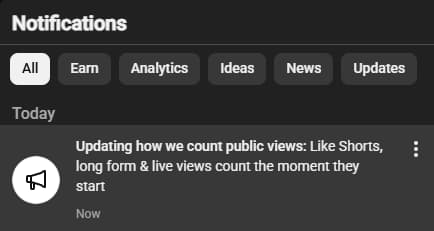
Updating how we count public views: Like Shorts, long form & live views count the moment they start
Official Link
An update to how we count public views across YouTube
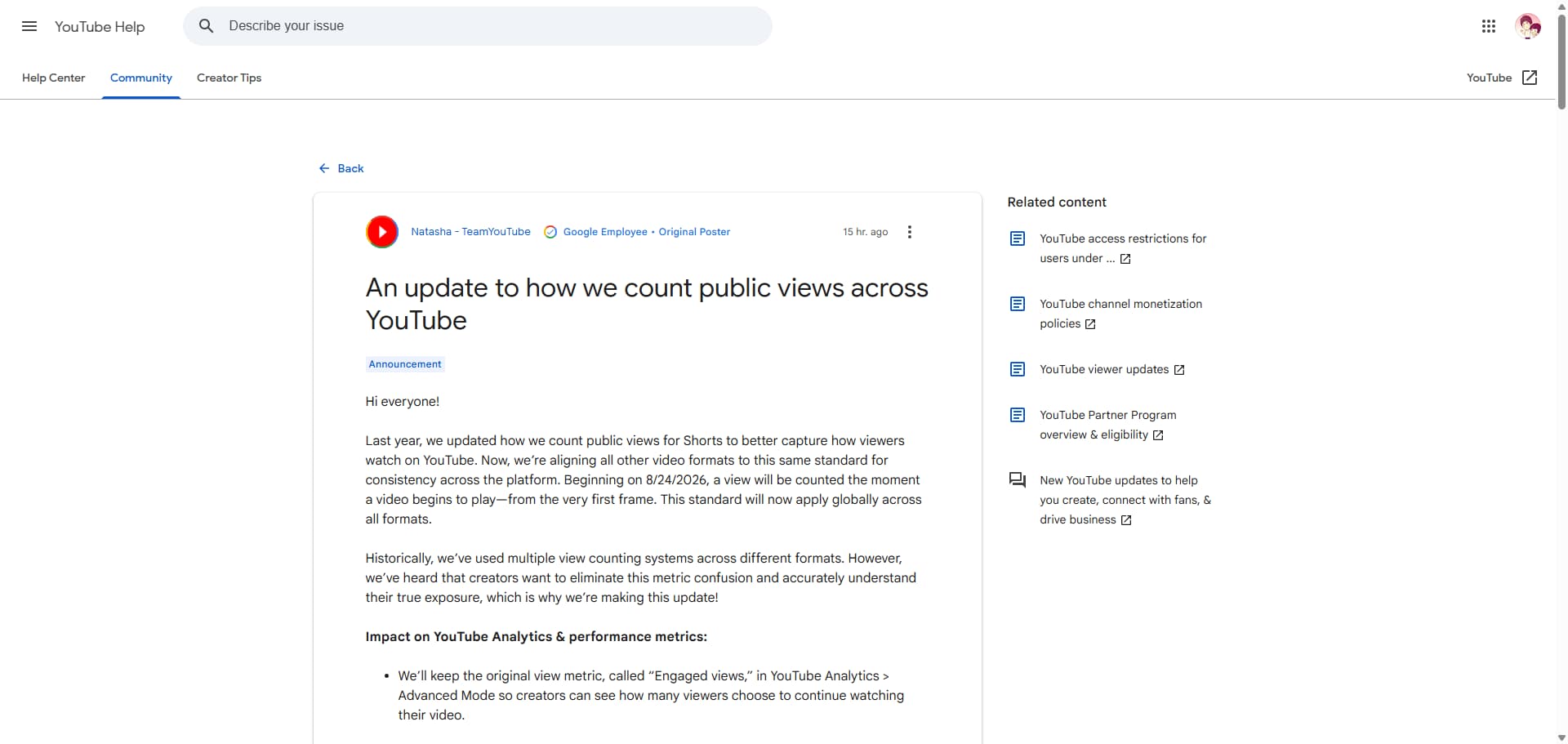
The official statement says this change will not affect YPP ad revenue, as ad revenue is calculated based on multiple data dimensions like watch time, and has little to do with play counts.
Thoughts
Whether it actually affects YPP revenue is certainly not up to the official statement.
According to the description, a long video will be counted as one play the moment it starts playing from the first frame. So, no matter how it’s triggered, even if it’s opened and immediately closed, it will theoretically be counted as one play.
For YouTubers’ data, this will clearly show an increase in play count data. It lets users see that, at worst, it’s not 0 plays. As long as they see more play counts, users’ willingness to watch videos will also increase.
For me, the change I can perceive is that previously, if someone watched a video, even by accidental touch, it might have been undercounted due to the old calculation method.
Now, after the update, theoretically, all genuine interactions are counted in the data, allowing me to understand more clearly who clicked and from where, without missing some data.
Positive Reinforcement
I currently focus on three data points:
One is the video’s recommendation volume. If a video has few plays and few recommendations, then it’s YouTube’s own problem; they aren’t providing traffic. For example, if there are 10 recommendations, you can’t expect 100 plays. But if it’s recommended 100,000 times, you’ll have at least 1,000 plays.
Another is play count. Play count determines revenue and the quality of the video content. To some extent, if users see a recommendation but don’t click, then either the thumbnail and title are problematic, or the content itself is niche.
The third is revenue. After all the effort to get plays, spending a day making a video, only to get $0.1 for a thousand plays – that’s not enough for food, not even for electricity. What’s the point then?
This change to video play count statistics, even if it doesn’t make more money, at least makes the play data look better. It can help me persevere for a while longer, rather than giving up immediately after painstakingly making a video only to get 0 plays. Or, even if the revenue is close to zero, at least a video with ten thousand plays looks good, and good data makes for a good mood.
Tips
Both creators and users are insignificant.
From YouTube’s official standpoint, raising YPP thresholds, setting Shorts ad revenue thresholds, and modifying long video play count methods are all about one thing: advertisers are fewer, revenue is down, and the platform needs to make its data look better so people are willing to advertise, and YouTube itself can generate revenue. This is essentially data beautification.
Because in this current environment, if data isn’t beautified, YouTube’s collapse isn’t impossible.
In short, this is not a technical optimization, but a data optimization for advertisers, nothing more.
And because advertisers’ spending isn’t high, it’s estimated that YPP revenue won’t increase much in the future. It has already significantly dropped by at least 3 times in recent days; what used to be $3 for the same plays is now less than $1. It might continue to decline.
Therefore, it is recommended to have your own products and not rely on YPP.