3D Gaussian Splatting
Project Repository: supersplat
A free, open-source tool designed for inspecting, editing, optimizing, and publishing 3D Gaussian Splatting scenes.
It runs directly in a web browser; you can try the online demo here: superspl editor
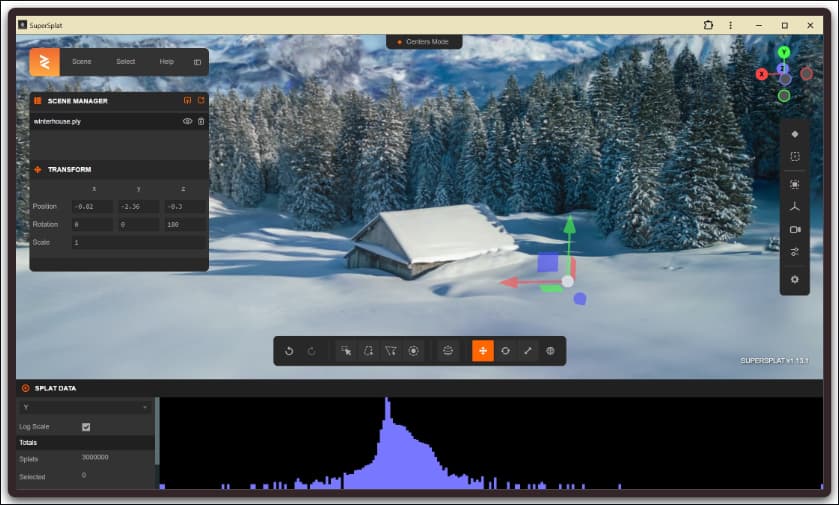
However, the limitation is that it only serves to display splats; it does not support converting video footage into splat files.
Free Commercial Solution
Use vid2scene to submit your mobile phone videos.
It will convert your footage into files compatible with supersplat. The advantage is that it is free of charge; the disadvantage is that it is not open-source.
I haven’t personally tried this yet; it was a website recommended to me by ChatGPT. I generally prefer solutions that are both open-source and free.
Free Open-Source Solution
Project Repository: StreamSplat
StreamSplat currently leans more toward being an academic framework and has a relatively low number of GitHub stars.
Its advantage is the ability to convert video footage into corresponding 3D files in real-time. Its disadvantages include a complex deployment process, high hardware requirements (specifically for graphics cards), and the fact that—being a relatively new project—it still contains numerous minor bugs that have yet to be resolved. Consequently, the final visual quality is somewhat inferior to that of vid2scene (though each solution has its own distinct strengths).
Use Cases
The first use case is particularly friendly to real estate agents: they can directly convert video footage into 3D files that can be viewed immediately within a web browser.
This eliminates the need for expensive 3D scanning technologies and production pipelines; a mobile phone is sufficient to render and view the 3D space, making the room’s layout and features instantly clear at a glance.
The second use case caters to people like me—individuals who wish to create 3D records of their surroundings. All that is required is a mobile phone. I’ve even heard of people recreating real-world locations—such as schools or tourist attractions—as fully explorable 3D game environments.
I’m making a note of this here for now, and I plan to give it a try later when I have the time.