Testing and Documentation
On YouTube:
In my first video, I shared Cloudflare Pages.
It allows you to deploy your static websites and blogs—such as the Astro-based site you are reading right now—completely free of charge.
In my second video, I discussed two open-source backend projects: Supabase and PocketBase. I personally recommend PocketBase—in fact, I am currently using it myself.
In the past, I used to focus exclusively on creating tutorials; it was exhausting work that yielded neither financial return nor positive feedback.
Now, I intend to simply document and share my thought processes. I will compile detailed tutorials only when time permits; otherwise, I’ll just offer some casual commentary. Sometimes, identifying the right path is even more crucial than the sheer effort put into the journey—and access to the right information is paramount.
Astro
This blog is powered by Astro.
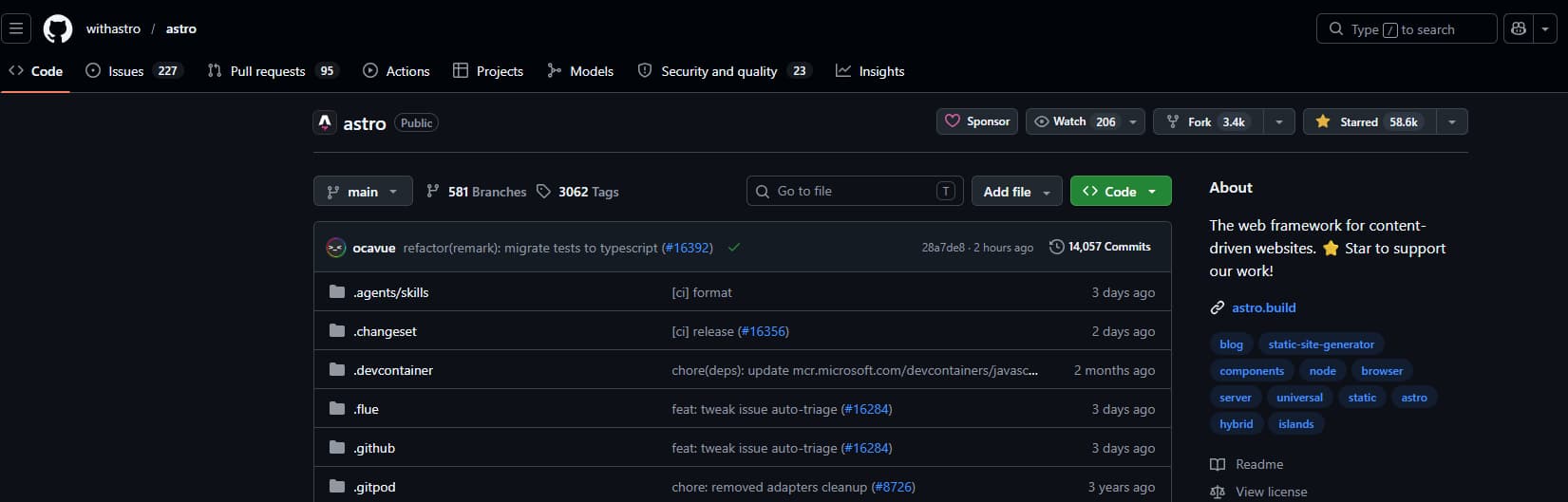
GitHub Repository: Astro
I intend to use it to build my static blog.
Since I happen to have a dormant domain name—one that hasn’t been used for many years—I’ve decided to put it to use this time around.
I plan to test whether a free blog hosted on Cloudflare Pages and built with Astro can be approved for Google AdSense, allowing me to display advertisements and generate revenue.
Furthermore, when recording YouTube videos, I intend to use my blog posts as the accompanying transcripts; this allows me to showcase my blog simultaneously while saving me the time I would otherwise have to spend separately formatting text and images.
Additionally, a static blog supports HTML content, making it much more convenient for me to visually demonstrate specific data points and concepts during my video presentations—including the use of charts, animated GIFs, and other dynamic elements.
Static Website
Compared to setting up an Astro blog, it is actually much faster to simply write a “Hello World” HTML file and deploy it on Cloudflare Pages.
All it takes is writing the code for a single div element and then directly uploading the resulting HTML file from the dist directory—a process I’m already familiar with, having previously deployed a navigation site.
I used to plan on independently developing websites or apps as a means of generating income, but I have since abandoned that ambition.
Now, I intend to implement only the most basic CRUD (Create, Read, Update, Delete) functionalities on my website—just enough to support Google Sign-In. I don’t require any sophisticated features; in fact, it could be as simple as a page displaying nothing more than a single greeting—and that is all.
Going forward, I plan to experiment with using PocketBase to power these features; I will provide a demonstration once I have successfully implemented them.